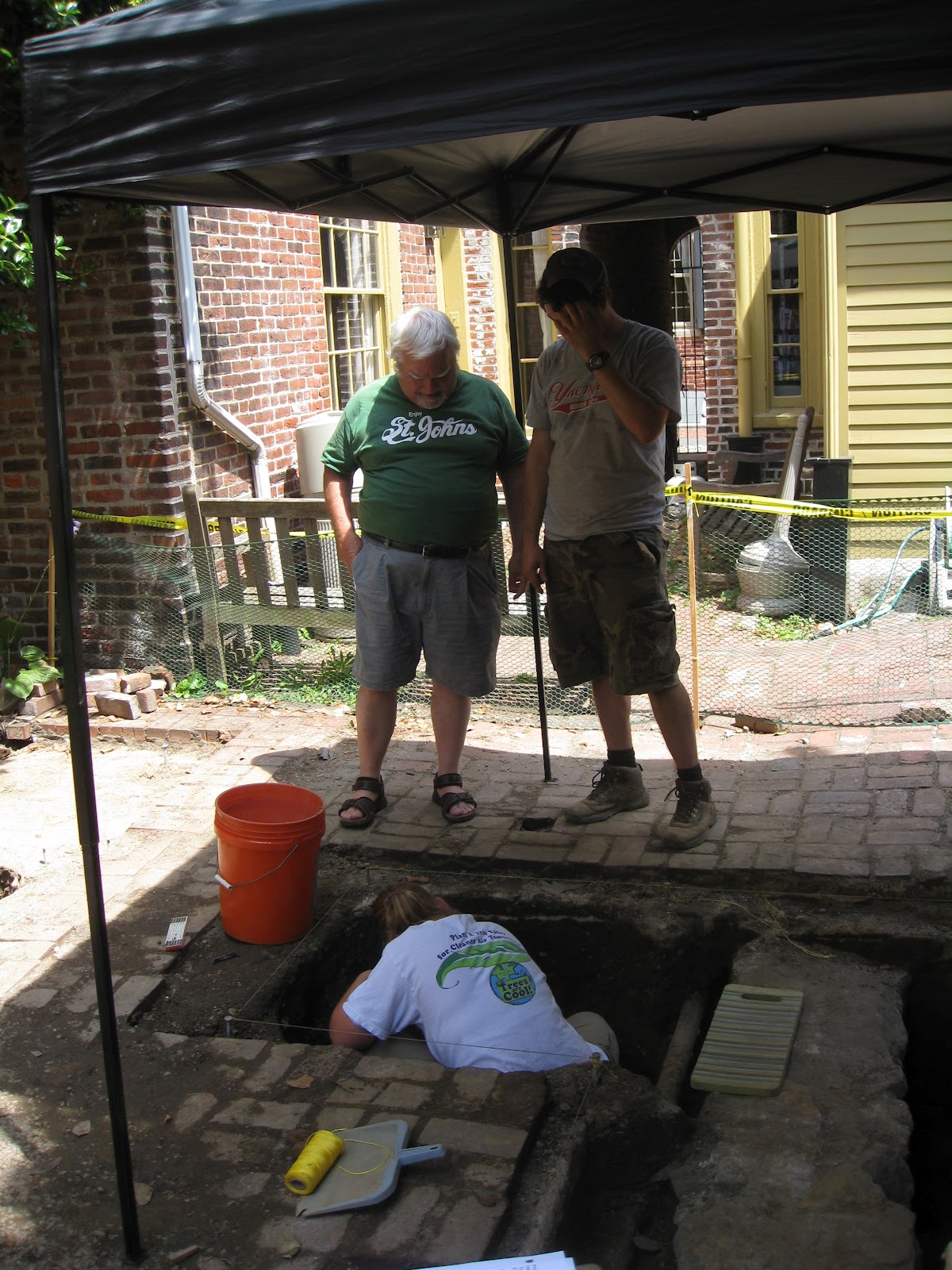
One of the best parts of the dig this summer has been working with the diverse group of volunteers who have come out to assist with excavation! The dedication of our volunteers has not faltered even when working through pouring rain and record breaking heat! The excavation at Elfreth’s Alley would not have been as successful (or as enjoyable) without the help of this truly devoted group of people.
To showcase our great volunteers and their tremendous work, this blog post highlights their experiences participating in the excavation. The volunteers were given the opportunity to share a bit about their time at the Alley - Here is what they had to say:
One of the best parts of the dig this summer has been working with the diverse group of volunteers who have come out to assist with excavation! The dedication of our volunteers has not faltered even when working through pouring rain and record breaking heat! The excavation at Elfreth’s Alley would not have been as successful (or as enjoyable) without the help of this truly devoted group of people.
To showcase our great volunteers and their tremendous work, this blog post highlights their experiences participating in the excavation. The volunteers were given the opportunity to share a bit about their time at the Alley - Here is what they had to say:

Working on the excavations at Elfreth's Alley has been a wonderfully fun and educational experience. There have been so many interesting parts of this dig but what stands out as the best has been to listen in while Deirdre and Matt discuss whether or not a new feature or strata has been found in a unit. It's fascinating listening to each of them justify their reasoning while pointing things out in the dirt and checking their paperwork. This has been such an incredible opportunity for volunteers and I'm very grateful to have been part of this project!
Wendy Miervaldis
Adjunct Professor, Math Department
Seton Hall University
The dig on Elfreth’s Alley has been a wonderful experience. Deirdre is a true teacher. Not only does she share the history of the area of the dig but she also allows the volunteers to enjoy the discoveries of fieldwork. It is like a treasure hunt: scrapping through the strata, loading the fill into buckets then piling a mound of dirt onto the screen. As we push the dirt through the screen allsorts of objects appear: window pane glass, nails, glazed brick, bottle glass of various colors, pottery shards and other unknown bits and pieces. Sometimes, while scrapping through the strata whole objects appear. It is fun to guess what objects could be and then to learn what they actually are. We look forward to unearthing more buried treasure in the coming weeks.
Gail Lovett
 Elfreth’s Alley was my first excavation in the USA—I’m originally from Greater Manchester, in the northwest of England. However, I had been on several archaeological excavations before. While doing grad work in classical archaeology (Greek and Roman), I worked on Mediterranean digs in my summers and, way back in the 1990s, I dug for a couple of field units in the UK
Wherever they’re from, archaeologists tend to record the same kinds of information, but the ways in which they record the information can vary dramatically. Thinking that I knew the “correct” way to describe something had the potential to cause even more confusion for the dig director than if I’d never been on a dig before, so I had to be careful to check that I was following the proper protocols.
Elfreth’s Alley was also my first real experience of historical urban archaeology. As I’d been warned, the stratigraphy could be quite complicated, with a lot of changes taking place in a relatively small area. Interesting and fun but, on more than one occasion, I ended up squinting at the layers and scratching my head, as I tried to figure out exactly what was going on.
I was delighted to be able to work in my adopted home city. My first experience digging in the USA was a very positive one (even with the 100 degree heat, at the end of my first week!) and I enjoyed my time working with Deirdre and her colleagues from Temple. I’d love to come back, next year (if they’ll have me).
David Platt
Library Services Assistant
Penn Libraries
Elfreth’s Alley has been an incredible experience. Having a degree in anthropology myself, I learned new techniques in archaeology that will help me excel in my career. My favorite thing about working on the site was meeting new people and hearing their experiences in archaeology. Finding new artifacts was a great bonus! I am so glad I was able to have this experience. Thank you for allowing me to participate on this excavation.
Alexa Rose
Being a part of the Alley over the last 7 years has been great. Meeting people and sitting on the Museum and Educational Committee has given me a greater understanding of this diversity of people that have come and gone on the years.
Volunteering at the dig, allows me to get a deeper and richer picture of the people and how they lived. Presently I am researching the Alley and by doing so I will be able to include the valuable information I have obtained at the dig.
Carol Haughey
A few years ago, my uncle Bill Clampffer discovered that we are direct descendants of Adam Klampfer, one of the original property owners of Elfreth's Alley. He also found sources that confirmed our Clampffer ancestors knew both George Washington and Benjamin Franklin! Since my uncle Bill died this spring, I've picked up the genealogy trail, and tried to learn more about the long history of my ancestors here in Philadelphia. When I heard about the dig at the Alley this summer, I immediately wanted to get involved. Although the focus of the dig is on more contemporary generations of Alley residents, it's been fun to get my hands dirty on the same street where my 6th great grandfather walked over 250 years ago.

I expected to unearth a lot of artifacts, but I've learned that a dig like this one isn't just about buttons and nails. On the days when I've volunteered, I've mostly been tasked with excavating "features," which I'll admit were hard to see with an untrained eye at first. Essentially, I've been excavating around areas where the soil color suggests something foreign once existed, such as a fence post. This past week, I worked in Unit 8, much of which is a jumble of loose bricks sticking out at all angles. Little by little, we worked our way down until things started to make sense, and we could determine which bricks were part of a foundation, and which seemed to be discarded construction debris.
I've volunteered on all kinds of field research projects before, from sea turtle tagging projects to rainforest mapping. What I've come to realize about archaeology is that as a science, it's not as easy as data in, data out. It takes a lot of time to measure and map each soil layer, and in the end, there's no easy way to punch data in a computer and produce an answer to the research question. I'll be very interested to read what's been learned from this dig in the end, and how the foundations, features, and artifacts we've unearthed this summer have added to our knowledge about immigrant life during the time period in question.
Debbie Hadley
The volunteers' responses underscore the diverse nature of archaeology and highlight the breadth of people who have come out to help. It has been great working with everyone and we look forward to working with you all in the future!

 October is Pennsylvania Archaeology Month! To celebrate the Philadelphia Archaeological Forum is hosting two great events that are free and open to the public. The first event, Part 1: Life in the City and Beyond, will be held Saturday, October 13th at the National Constitution Center, Kirby Auditorium. The second event, Part 2: Life Along the River, will be held Saturday, October 20th at Independence Seaport Museum. Both events promise to be exciting and informative! Be sure to stop by to learn about Philadelphia's buried past!